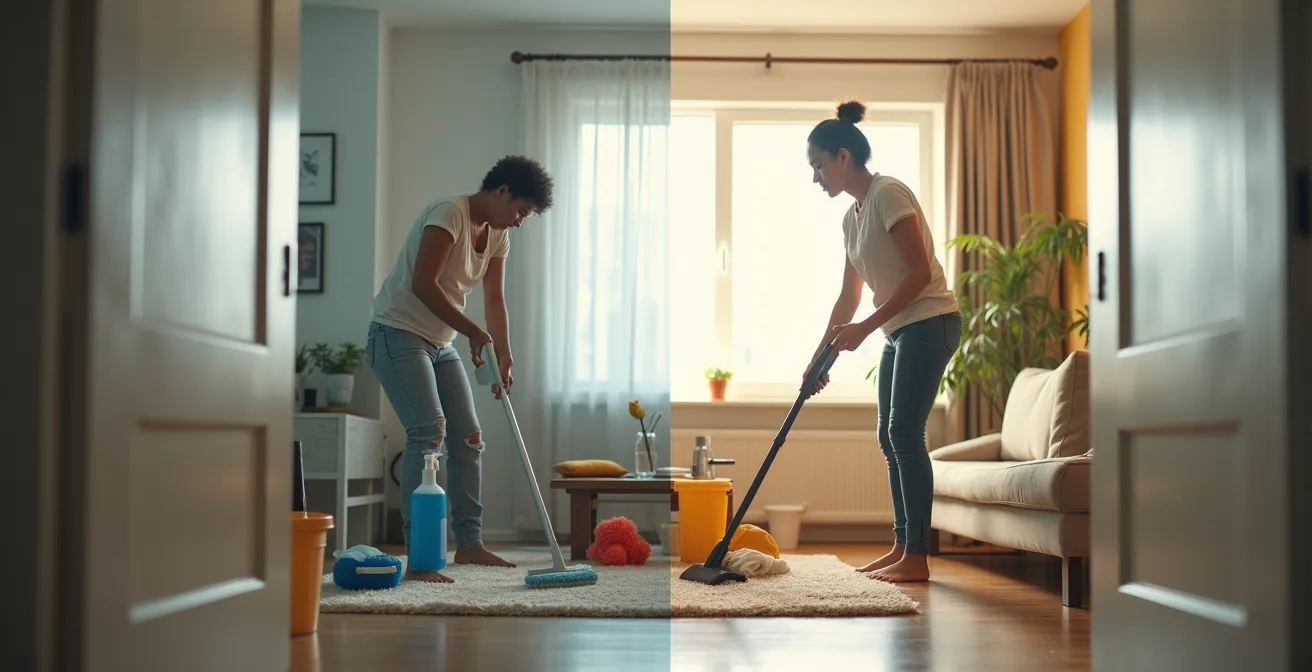
The decision to hire professional cleaning services often triggers an internal debate. Most homeowners weigh the visible price tag against the perceived simplicity of doing it themselves, concluding that DIY represents the frugal choice. This comparison, however, operates on an incomplete ledger.
Beyond the surface-level cost analysis lies a complex ecosystem of hidden expenses, opportunity costs, and long-term value propositions that fundamentally reshape the economics of this decision. Whether you’re managing a busy household or running a business facility, partnering with a reliable cleaning company represents more than outsourcing chores—it’s a strategic investment in time reclamation and quality assurance.
The real question isn’t whether professional cleaning costs money, but whether the alternative—managing everything yourself—costs more in ways you haven’t accounted for. This analysis moves beyond generic “saves time” platitudes to provide a personalized decision framework that evaluates your specific situation, quality expectations, and life priorities.
Professional Cleaning Investment Essentials
- DIY cleaning carries invisible costs: opportunity loss, equipment waste, damage risk, and energy depletion affecting other life areas
- ROI calculation requires personalized variables: your hourly value, home size, cleanliness standards, and life stage circumstances
- Quality indicators distinguish value from waste: consistency scoring, insurance verification, and accountability systems matter more than hourly rates
- Compound benefits accumulate over time: asset preservation, productivity gains, and relationship quality multiply initial investment value
- Honest scenarios exist where DIY makes more sense: small spaces, tight budgets, personal preference, or specific control needs
The Real Price of ‘Free’ DIY Cleaning
The illusion of free labor collapses under scrutiny. When you clean your own home, you’re not avoiding costs—you’re simply paying in a different currency. The first hidden expense appears in your calendar: the average homeowner spending three hours weekly on cleaning translates to over 150 hours annually that could have been directed towards revenue-generating tasks.
This time investment represents pure opportunity cost. If your professional hourly rate is $50, those 150 hours translate to $7,500 in foregone income. Even for those not directly trading time for money, those hours could have been invested in skill development, business planning, creative projects, or simply recharging mental reserves that improve performance in other domains.

The equipment dimension presents another miscalculated expense. DIY cleaning requires an arsenal of tools: vacuum cleaners, mops, specialized brushes, and an ever-expanding collection of surface-specific cleaning solutions. Consumer-grade equipment typically costs $500-$675 upfront, with ongoing replacement cycles and storage requirements that accumulate to hundreds annually.
The cleaning services market’s projected growth from USD 415.93 billion in 2024 to USD 616.98 billion by 2030, at a CAGR of 6.9%, reflects a fundamental economic reality: as more people calculate these hidden costs, professional services emerge as the rational choice. This expansion isn’t driven by laziness but by mathematical clarity about where value truly lies.
| Cost Factor | DIY Cleaning | Professional Service |
|---|---|---|
| Time Investment | 8-12 hours/week | 0 hours |
| Equipment Cost | $500-$675 initial | Included in service |
| Opportunity Cost | $3,000+ annually | $0 |
| Damage Risk | High (untrained) | Low (insured) |
Perhaps the most overlooked expense is the damage cost audit. DIY mistakes—using acidic cleaners on marble, applying excessive water to hardwood, or employing abrasive techniques on delicate surfaces—create repair bills that can reach thousands. Professional services carry insurance and expertise that eliminates this risk category entirely.
The learning curve tax compounds these costs. The hours spent researching proper techniques, watching tutorials, and trial-and-error experimentation represent an educational investment that professionals have already made. You’re essentially paying tuition to learn skills you’ll use infrequently, while specialists apply that knowledge daily with compounding efficiency gains.
Energy depletion creates spillover effects rarely accounted for in cost comparisons. The physical and mental exhaustion from a weekend deep clean doesn’t disappear—it reduces your effectiveness in parenting, work performance, creative output, and relationship quality during the following week. This cognitive load and physical fatigue represent real costs with measurable impacts on life quality.
The ROI Formula for Your Specific Situation
Generic claims that professional cleaning “pays for itself” lack actionable precision. The actual return on investment varies dramatically based on individual circumstances, requiring a personalized calculation framework rather than one-size-fits-all assertions.
The base calculation provides a starting point: multiply your true hourly value by the weekly hours spent cleaning, then by 52 weeks to generate an annual opportunity cost. Compare this figure against the annual cost of professional services. The challenge lies in honest hourly value assessment—this isn’t just your current wage, but the value of incremental time for business development, skill acquisition, or quality-of-life activities that have monetary or wellbeing equivalents.
Market data reveals strong adoption patterns that validate this calculation. Research indicates that the US Department of Commerce expects 80% of two-income households to use an outside house cleaning service within the next few years, reflecting a demographic that has completed precisely this ROI analysis and reached a clear conclusion.
Critical variables require adjustment for accurate personalization. Home square footage directly impacts both DIY time requirements and professional service costs. A 3,000 square foot home demands fundamentally different resource allocation than an 800 square foot apartment. Cleanliness standards matter equally—maintaining magazine-ready presentation requires exponentially more effort than basic sanitary maintenance.
ROI calculation framework
- Fixed costs stay constant regardless of how many homes you’re scrubbing clean, including office space, utilities, insurance, and equipment maintenance
- Variable costs include supplies, transportation, and labor – accurately calculating these costs for each job ensures you’re not wiping away your profits
- Hidden costs are easy to miss but crucial to address, including insurance, taxes, licensing fees, and miscellaneous expenses
- By accurately accounting for all costs and incorporating a reasonable profit margin, you maximize your earnings
Physical limitations and household composition create multiplier effects. Individuals with mobility issues, chronic pain, or health conditions that make cleaning physically demanding face higher DIY costs. Households with multiple occupants, pets, or young children generate accelerated mess cycles that amplify time requirements.
Break-even analysis identifies threshold moments. For professionals billing $75+ per hour, the math tilts decisively toward delegation at standard cleaning frequencies. For entrepreneurs where time directly converts to business growth, the calculation becomes even more compelling. Life stage transitions—new parenthood, caring for elderly relatives, career acceleration phases—create temporary or permanent shifts in this equation.
| Metric | 2024 Value | Growth Rate |
|---|---|---|
| Global Market Size | $415.93 billion | 6.9% CAGR |
| North America Share | 36.4% | 4.8% CAGR |
| Software Market | $2.65 billion | 10.3% CAGR |
| EPA Indoor Air Quality Cost | Tens of billions yearly | N/A |
Comparative investment analysis positions professional cleaning against other lifestyle services. A gym membership costs $50-$150 monthly for health benefits that manifest over years. Therapy sessions run $100-$250 per hour for mental health maintenance. Meal kit services charge $60-$120 weekly to reclaim dinner preparation time. Professional cleaning occupies a similar category—a recurring investment in life quality with measurable returns across multiple dimensions.
Increasing revenue is the primary goal for 63% of businesses, followed by improving cash flow (57%) and hiring or retaining employees (54%). Customer retention is essential to contractors, as repeat business represents the most significant source of revenue (37%)
– Your Aspire, Commercial Cleaning Industry Trends
The Value Indicators Beyond a Clean Floor
Price alone provides insufficient guidance for evaluating professional cleaning services. The market reflects this complexity: the typical range is $90 to $600, with a national average cost of cleaning services being $170, creating a 6x variance that demands quality assessment criteria beyond simple cost comparison.
Consistency assessment provides the first quality marker. Create a standardized checklist covering 10-15 detail areas—baseboards, light fixtures, cabinet fronts, grout lines, window sills—and score results across multiple sessions. Reliable services demonstrate minimal variance between visits, while inconsistent providers show erratic performance that undermines the value proposition.

The distinction between surface cleaning and deep maintenance reveals itself through longevity tests. How many days does true cleanliness last? Services that deliver genuine deep maintenance extend the intervals between sessions, whereas surface-level cleaning requires more frequent visits to maintain standards. Inspection of hard-to-reach areas—behind appliances, inside vents, upper shelving—separates thorough services from cosmetic ones.
Insurance and accountability systems function as non-negotiable quality indicators. Professional operations carry comprehensive liability coverage that protects clients from financial responsibility in case of accidents or damage. This insurance requirement filters out casual operators and signals serious business practices.
Safety is a top priority for professional cleaning companies. They equip their teams with the necessary personal protective equipment (PPE) and train them in the proper safety protocols. Most reputable cleaning companies carry liability insurance, which means that if an accident does occur, you’re protected from financial responsibility
– MNZ Janitorial Services, The Hidden Costs of DIY Construction Cleanup
Communication responsiveness serves as a proxy for overall service quality. How quickly do they respond to inquiries? Do they proactively communicate schedule changes? Is there a clear problem resolution process? Services that excel in these areas typically demonstrate the same attention to detail in their actual cleaning work.
| Quality Indicator | Professional Service | DIY Approach |
|---|---|---|
| Consistency | Standardized processes | Variable results |
| Insurance Coverage | Full liability protection | Personal risk |
| Equipment Quality | Commercial-grade | Consumer-grade |
| Training Level | Certified professionals | Self-taught |
Price-to-value red flags help identify poor investments despite competitive pricing. Rushing through agreed areas, high staff turnover, lack of supervision, and absence of quality control systems all indicate services that won’t deliver sustainable value. A slightly higher price from a service demonstrating opposite characteristics—deliberate pacing, stable team, active supervision, systematic quality checks—represents superior ROI.
The presence of satisfaction guarantees and willingness to address concerns separates confident professionals from those aware their work won’t withstand scrutiny. Services that offer re-cleaning for missed areas or money-back assurances signal both quality confidence and customer-centric business models. This dimension often correlates more strongly with long-term satisfaction than initial pricing.
The Compound Returns of Consistent Professional Care
Single-instance cost-benefit calculations miss the accumulating advantages that emerge from sustained professional maintenance. The compound interest principle applies to cleaning services: consistent care creates exponential returns that transform the investment from recurring expense to strategic asset protection.
Preventive asset protection delivers quantifiable long-term savings. Regular professional maintenance extends flooring lifespan by 5-10 years through proper techniques that avoid degradation from incorrect cleaning methods. Professional care prevents appliance deterioration by addressing buildup before it causes mechanical issues. These avoided costs compound over 3-5 years into thousands of dollars in replacement delays and damage prevention.
The industry’s employment trajectory reflects this expanding recognition. Data shows that the British Cleaning Council (BCC) projected the UK cleaning industry would create 93,000 new jobs by 2024, with 29% classified as ‘hard to fill’, indicating robust demand that exceeds supply—a market signal of genuine value creation rather than discretionary luxury.
Mental bandwidth liberation generates returns that extend far beyond immediate cleanliness. Delegating cleaning removes an entire management system from your cognitive load—no more weekend planning, product research, or schedule coordination for this domain. This decision fatigue reduction creates measurable productivity gains in other areas where that mental energy gets redirected.
The productivity spillover manifests in unexpected ways. Research consistently demonstrates connections between organized environments and work performance. Consistent professional cleaning maintains a baseline of order that correlates with improved focus, creative output, and decision-making quality. For knowledge workers and entrepreneurs, these cognitive benefits can translate directly to career advancement and income growth.
| Benefit Category | Short-term Impact | Long-term Value |
|---|---|---|
| Time Savings | 3-5 hours weekly | 150+ hours annually |
| Equipment Investment | $0 upfront | $500+ saved on equipment |
| Surface Protection | Proper techniques used | Extended material lifespan |
| Health Benefits | Professional-grade sanitization | Reduced illness risk |
Relationship dividends represent perhaps the most undervalued return category. Household management conflicts decrease when cleaning responsibility shifts from internal negotiation to external service. The reclaimed weekend hours transform from chore completion to quality family time, strengthening social bonds. Enhanced hosting capability—confidence in home presentation without pre-guest panic cleaning—improves social connection frequency and quality.
Hiring professional cleaners can be a significant investment, but it’s worth considering the value they bring to your home and life
– eufy US, Home Cleaning Prices 2025 Pricing Guide
The health dimension compounds over time through consistent professional-grade sanitization that reduces illness frequency. While difficult to quantify precisely, reduced sick days and improved overall wellness represent tangible value that accumulates across years of maintained service.
Key Takeaways
- Calculate your true hourly value and opportunity cost to determine personalized breakeven points for professional services
- Evaluate quality through consistency scoring, insurance verification, and accountability systems rather than price alone
- Compound benefits accumulate over years through asset preservation, productivity gains, and relationship quality improvements
- Honest assessment reveals specific scenarios where DIY makes sense versus when professional services optimize value
- Decision frameworks should incorporate life stage, household composition, and personal priorities beyond simple cost comparison
The Decision Map: When It Makes Sense, When It Doesn’t
Counter to industry marketing that positions professional cleaning as universally beneficial, honest analysis reveals specific scenarios where DIY represents the optimal choice. This transparency serves decision-making better than one-sided advocacy.
DIY genuinely outperforms professional services in several situations. Early career phases with tight budgets and abundant time create circumstances where sweat equity makes mathematical sense. Small apartments under 800 square feet require minimal time investment that doesn’t justify service costs for many individuals. Those who find cleaning meditative or genuinely enjoy the process derive psychological benefits that reverse the typical value equation.

Control needs and highly specific cleanliness standards sometimes make DIY preferable. Individuals with particular organizational systems, specific product preferences, or exacting standards that exceed professional service norms may find the customization limitations of external services frustrating. In these cases, the personal control value outweighs time savings.
Market data contextualizes these decisions: the residential cleaning services market in the U.S. is valued at approximately $18.8 billion, showing a moderate growth of 1.23% from the previous year, indicating steady demand from those who have identified themselves in the sweet spot profiles for professional services.
Those sweet spot profiles include dual-income households with children, where both time scarcity and financial capacity align. Entrepreneurs and high-billable-hour professionals where opportunity cost calculations tilt decisively toward delegation. Individuals with health limitations, mobility issues, or chronic conditions that make cleaning physically demanding or impossible. Life transition phases—new parenthood, elderly care responsibilities, intensive career demands—create temporary or permanent shifts favoring professional services.
Service level decision criteria
- Deep cleaning services go beyond standard cleaning, addressing areas not typically covered. Prices for deep cleaning can range from $200 to $400, significantly higher than standard cleaning due to the intensity and time required
- Move-out cleaning is designed for tenants moving out or homeowners preparing a home for sale. Move-out cleaning can cost up to $500, ensuring every nook and cranny is cleaned
- After construction or renovation work, post-construction cleaning removes all traces of dust, debris, and building materials. Given the specialized nature of this cleaning, costs can be high
Hybrid optimization strategies offer middle-ground solutions that maximize value. Delegating the most time-intensive or physically demanding tasks—bathrooms, floor care, dusting—while retaining personal spaces and organizational tasks creates efficient division of labor. This approach captures most time savings while reducing overall service costs.
Phasing strategies allow gradual testing. Start with monthly deep cleaning while maintaining weekly DIY maintenance, then adjust frequency based on actual value experienced. Trial periods of 3 months provide sufficient data to evaluate whether the investment delivers promised returns in your specific circumstances.
In 2024, budgeting for cleaning services requires navigating new market realities, including evolving health standards in a post-pandemic world, inflationary pressures on supplies and equipment, and a competitive labor market
– HouzGuide, School Cleaning Costs 2024 Guide
Decision-making self-audits provide structure for this evaluation. Consider values alignment: do you prioritize time flexibility or financial optimization? Conduct honest budget reality checks: can you afford services without financial stress, or would the cost create anxiety that undermines wellbeing benefits? Establish periodic reassessment triggers—income changes, household composition shifts, life stage transitions—that prompt recalculation rather than defaulting to historical patterns.
The framework ultimately serves personal optimization rather than universal prescription. Whether exploring professional industrial cleaning for business facilities or residential services for your home, the decision should reflect your specific circumstances, priorities, and honest assessment of where your time and energy create maximum value. For those preparing for transitions, practical considerations like packing tips for moving demonstrate how delegating specific tasks during high-stress periods can preserve mental bandwidth for critical decisions.
Frequently Asked Questions on Professional Cleaning
How long does professional cleaning take compared to DIY cleaning?
Professional estate cleanout services typically complete most residential properties in 1-3 days. DIY cleanouts generally take much longer—typically 2-4 weeks for average homes when working evenings and weekends. This time difference reflects both professional efficiency and the reality that most homeowners can only dedicate limited hours outside of work commitments.
What insurance benefits do professional cleaning services provide?
Professional estate cleanout services should carry appropriate insurance that protects you from financial responsibility if accidents or damage occur during cleaning. Some services charge additional fees for enhanced insurance coverage on high-value estates, typically 1-3% of estimated asset value. This coverage eliminates the personal liability risk inherent in DIY cleaning.
How do I calculate whether professional cleaning makes financial sense for my situation?
Start with your true hourly value—what you earn or could earn with that time. Multiply by the hours you spend cleaning weekly, then by 52 weeks. Compare this annual opportunity cost against professional service costs. Adjust for variables like home size, cleanliness standards, physical limitations, and life stage. If opportunity cost significantly exceeds service cost, professional cleaning represents positive ROI.
What quality indicators separate valuable professional services from overpriced ones?
Look for consistency across multiple sessions using a standardized checklist of detail areas. Verify insurance coverage and licensing. Evaluate communication responsiveness and problem resolution processes. Check for satisfaction guarantees. Assess whether cleaning addresses deep maintenance or just surface appearance. These factors matter more than hourly rate in determining long-term value.